
The benefits of outdoor learning and nature/forest schools sound great! Developing resilience, better skills in communicating, problem solving, critical thinking and teamwork, becoming an environmental steward, better academic outcomes in school aged children …. and wading through the research on each of these is difficult. Some is poorly designed, a lot is behind pay walls, and just the sheer number of studies to look at is quite daunting. A newly published research paper is helping bring more clarity to the question of whether and how often these benefits are really seen – and the news is good.
Dr. Ming Kuo (University of Illinois, Urbana/Champaign), and Drs. Michael Barnes and Catherine Jordan (both University of Minnesota) published Do Experiences with Nature Promote Learning? Converging Evidence of a Cause-and-Effect Relationship, looking to sort through the current, well-designed research to find evidence of these claims and of the mechanisms by which nature based education supports these outcomes. I’ll summarize below, however I highly recommend reading the paper here. Links to the research looked at can be found here, also.
The short story, yes – the authors found research is supporting that nature based education promotes three areas of a child’s development: personal development, academic achievement, and environmental stewardship. Eight pathways are identified as contributing to these benefits.
The first five pathways are learner based. Previous research has linked better learning to a learner being more attentive, less stressed, more self-disciplined, more engaged and interested, and more physically active and fit. Nature based education research has shown nature’s rejuvenating effects on attention and ability to help with stress relief, impulse control improvement in children during and after contact with nature, an increase in student motivation, enjoyment, and engagement in natural settings, and that time outdoors is tied to higher levels of physical activity and fitness.
The next three pathways focus on how natural settings can provide a more supportive environment for learning. Natural environments are calmer and quieter than many indoor learning environments, partly due to less problematic and disruptive behavior and fewer conflicts. Warmer, more cooperative relationships are fostered as there is more freedom to engage with each other and form ties. These cooperative learning environments promote student engagement and academic performance. And finally, natural settings appear to promote different forms of play, such as more opportunities for “loose parts” play, that have been shown to result in more creative, physically active, and social play, more autonomy, and more opportunities for authentic problem solving.
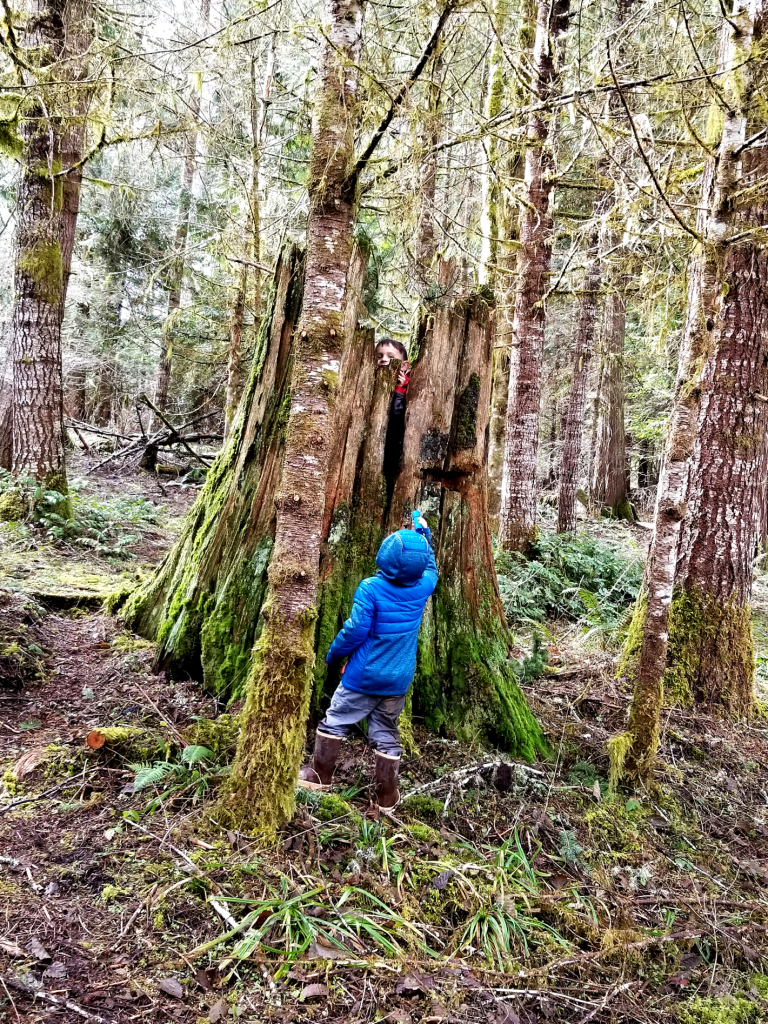
We just finished up our first three weeks of outdoor preschool and I can definitely see all these pathways at work. The students are an amazing group of three and four year olds who are enthralled by everything we find in the forest and spend their school time exploring, questioning, experimenting, pretending, and creating – while making new friends and alliances and having so much fun! I have not seen the beginning of school stress or behavior management problems that were usual in my years of teaching at a very high quality indoor preschool. I expected it to take a month or more for a close knit learning community to form – it’s mostly developed now. They are beginning to watch out for each other, helping friends who trip on the darn trailing blackberry vines and pointing them out to everyone ahead of time, problem solving ways to share or find more of popular resources, and negotiating who is which type of monster in wonderfully detailed dramatic play. I can’t wait to see what the coming weeks bring!

 Songbird Nature School